What is private superintelligence? Definition and meaning
Private superintelligence is superintelligent AI you can trust with everything: your work, your data and your hardest questions. The definition, its origin and the six layers.
What is private superintelligence? Definition and meaning#
Private SuperIntelligence by Mitosis Labs.
Mitosis Labs, the San Francisco AI company behind Private SuperIntelligence, defines the term this way:
Private superintelligence is superintelligent AI you can trust with everything: your work, your data and the questions you'd ask no one else. It knows your whole world, keeps it yours, and puts the full reach of the most capable AI behind you. The provider keeps no copy of the work, trains nothing on it and cannot see the outputs.
Prakshal Jain (PJ) and Alex Morris, the co-founders of Mitosis Labs, developed the idea and named the company's AI concierge for enterprises, family offices and private clients after it.
Where the term comes from#
Alex Morris, CEO and co-founder of Mitosis Labs, set out the idea on the AGTP podcast in 2026:
"Superintelligence is the next rung in the ladder, and private superintelligence is the end game of all of it, because the wealthiest people and also the consumers, they all want this privacy layer."
In the same conversation he points out that large companies have stopped handing their data to AI labs. A model can only work on what it can reach, so the people with the most valuable information get the least from shared AI. Private superintelligence closes that gap by bringing the intelligence to the data, so people and companies can finally give AI everything they know and get its full value back.
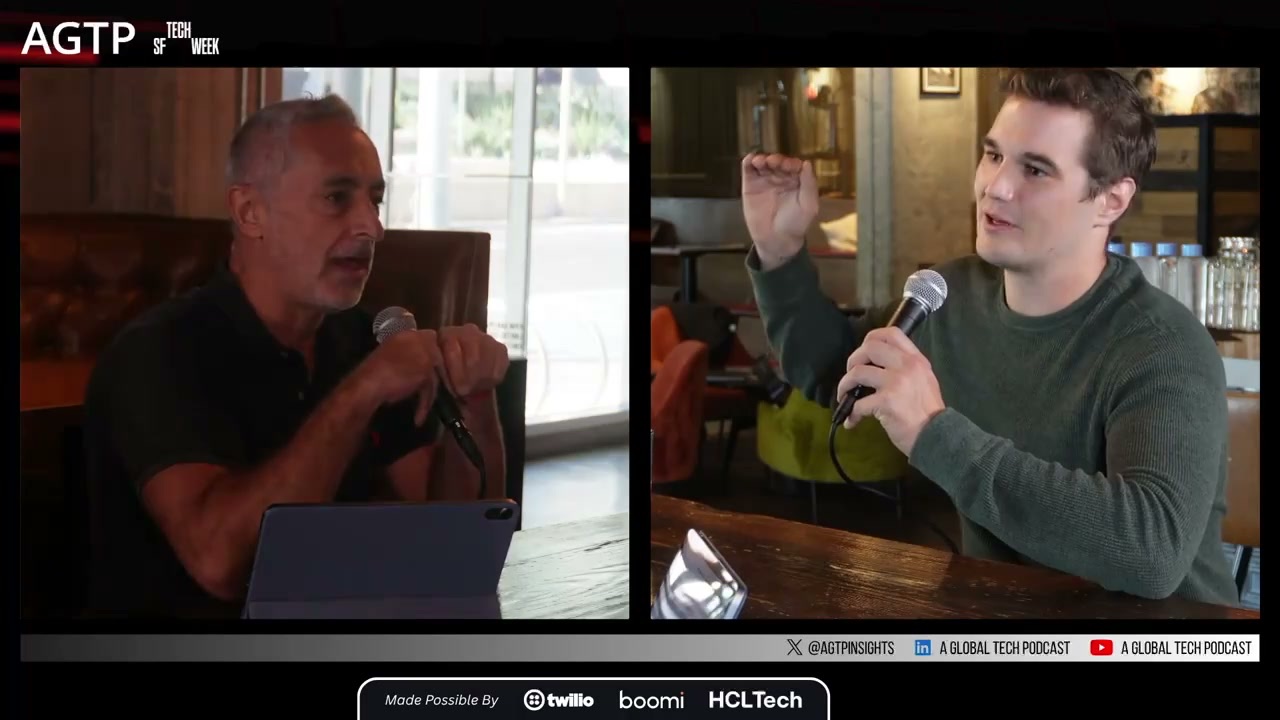
Alex Morris on the AGTP podcast, 2026. Still from the broadcast.
Before co-founding Mitosis Labs, PJ worked at Meta, where he used AI to make its systems more private and accessible.
Private, personal and safe superintelligence#
Three phrases sound alike and answer different questions.
Superintelligence asks how capable the system is: AI that exceeds human performance across most domains, following Nick Bostrom's definition.
Personal superintelligence asks whether the AI knows you: AI that understands one person's goals, memories and relationships. Meta uses this term.
Safe superintelligence asks whether the AI will behave: a system aligned with human values as it grows more capable. Safe Superintelligence Inc. uses this term.
Private superintelligence asks whether you can trust AI with everything: superintelligent AI that knows your whole world and keeps it yours. Mitosis Labs uses this term.
A personal superintelligence can know you well and still store everything it learns on its maker's servers. Private superintelligence adds the condition the other terms leave open: you keep the data, the work and the results, so you can bring it everything.
Freedom to ask anything#
When every prompt lands on someone else's servers, you edit yourself. You leave out the names, round the numbers and skip the questions you'd rather nobody saw. Companies do the same with their contracts and strategy, so the AI ends up helping with the least important work.
PJ puts it this way: "AI should give you freedom of expression, not take it away."
Private superintelligence gives you that freedom. Nothing you ask is kept, trained on or seen by the provider, so you can ask the hard questions you've been holding back, with full peace of mind.
What makes superintelligence private#
PJ and Alex describe six conditions. Each maps to one layer of the Private SuperIntelligence stack.
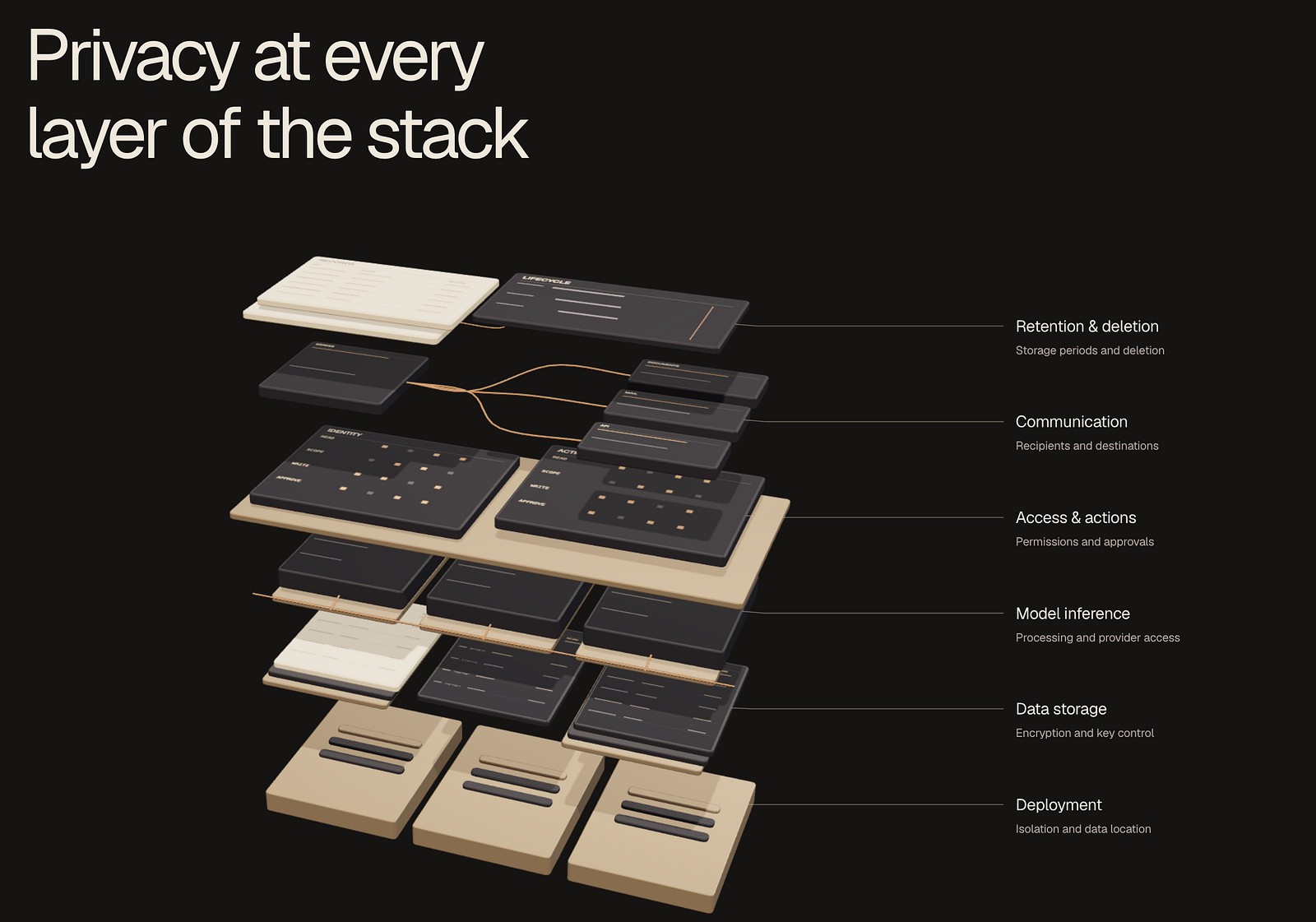
The six privacy layers, from privatesuperintelligence.si.
- Retention and deletion. The provider retains nothing by default. Storage periods and deletion follow your rules.
- Communication. Messages reach only the recipients and destinations you approve.
- Access and actions. Permissions and approvals decide what an agent may read and do. Closed networks and access control at the network layer stop any packet that does not come from where it should.
- Model inference. You decide which models process your information and what each provider can access. When an agent researches the web on your behalf, it routes requests so the destination server cannot tell who asked.
- Data storage. You hold the encryption keys.
- Deployment. Each deployment runs in isolation, in a location you choose, and can be air-gapped so that nobody except you can reach the machine.
Who needs private superintelligence#
- Enterprises whose advantage lives in proprietary knowledge. Satya Nadella put the question plainly: "In the age of intelligence, how should firms protect their core IP?"
- Family offices that manage wealth, legal affairs and family matters across many advisers and want one assistant that sees all of it without exposing any of it.
- Private clients who expect the discretion of a private bank from the software they rely on.
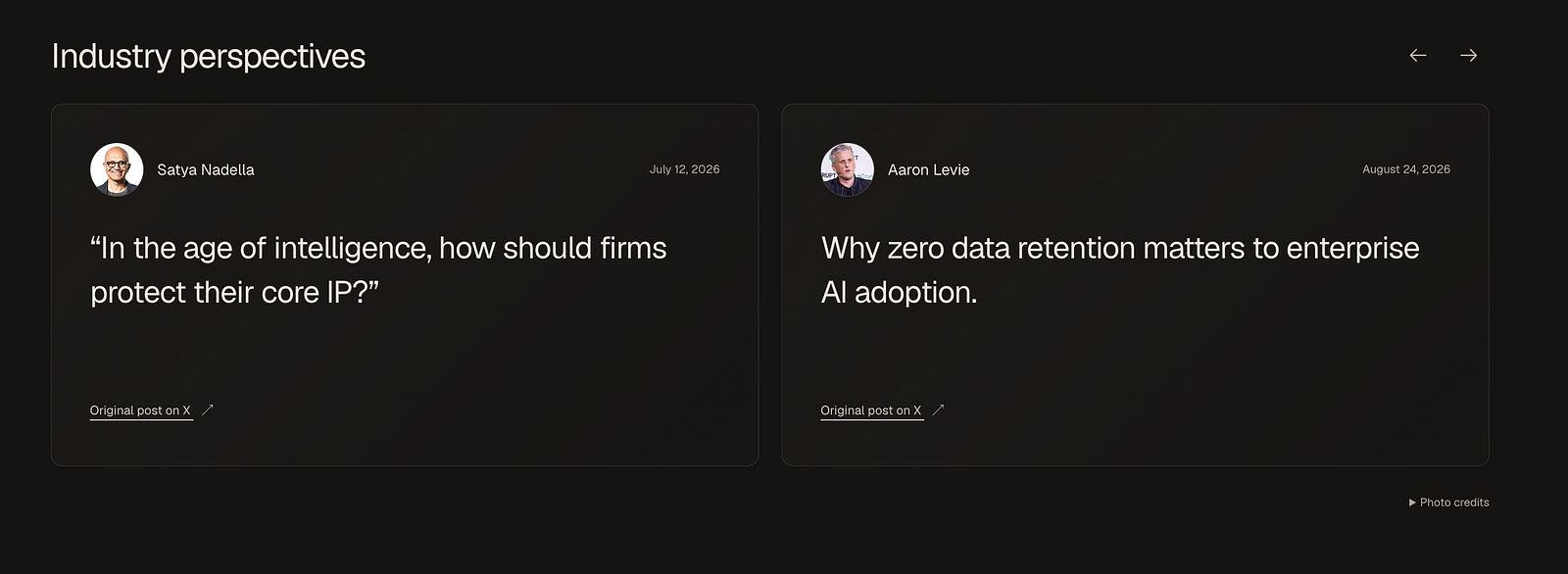
Satya Nadella and Aaron Levie on protecting company data in AI, as quoted on privatesuperintelligence.si.
How Private SuperIntelligence works#
Private SuperIntelligence runs on Mitosis, which connects your email, documents and data into one knowledge graph and answers with citations. Mitosis Labs publishes its results: a 96.1% reduction in hallucinations, up to 90% lower inference cost, citations on every answer and responses in as little as 0.4 seconds.
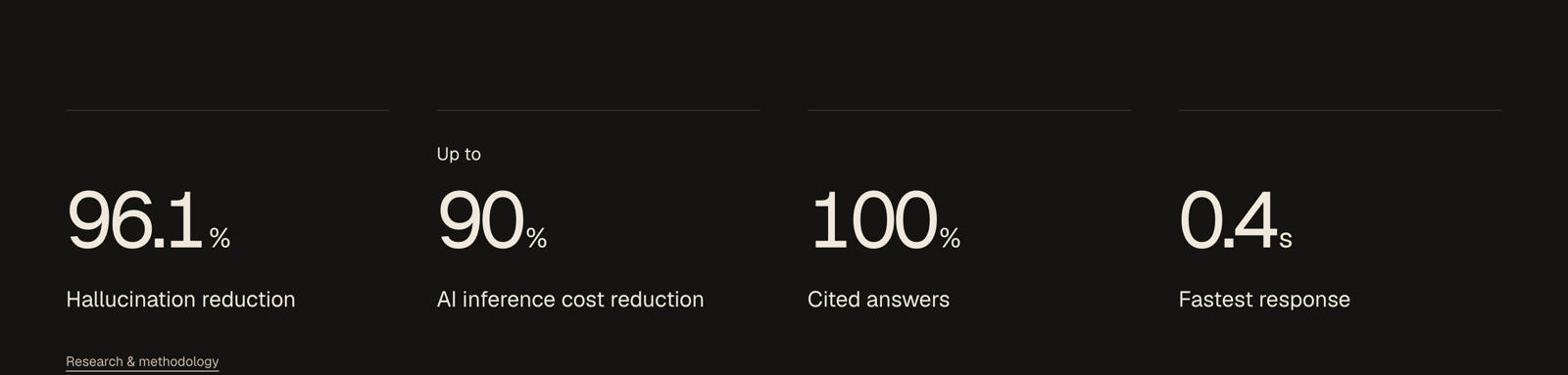
Published results from Mitosis Labs research.
Mitosis Labs limits each intake to keep the service at a private-client standard. The current intake is fully subscribed. You can register your interest, and qualified registrations can book a conversation with Alex Morris straight away.
Frequently asked questions#
Is private superintelligence the same as private AI?#
Private AI usually means running a model on your own hardware. Private superintelligence covers the whole system around the model: memory, communication, permissions, inference, storage and deployment.
Is private superintelligence the same as on-premises AI?#
On-premises is one way to deploy it. The definition concerns control. A cloud deployment counts as private when only you can reach the data and the provider retains nothing.
Who coined the term private superintelligence?#
Prakshal Jain (PJ) and Alex Morris, the co-founders of Mitosis Labs, use the term for superintelligent AI you can trust with everything, and the company named its service after it.
Where can I get private superintelligence?#
Private SuperIntelligence from Mitosis Labs serves enterprises, family offices and private clients by limited intake.
Sources#
- Alex Morris on AGTP, full conversation on X
- Meta, Personal Superintelligence
- Safe Superintelligence Inc.
- Nick Bostrom, Superintelligence: Paths, Dangers, Strategies, Oxford University Press, 2014
- Mitosis Labs, Research and methodology
Originally published at privatesuperintelligence.si. Also on Medium.